Epoxy vs. Polyurea Garage Floors: How We Choose
Trying to choose between epoxy and polyurea for your garage floor? Learn how we match each system to your concrete, budget, and timeline.
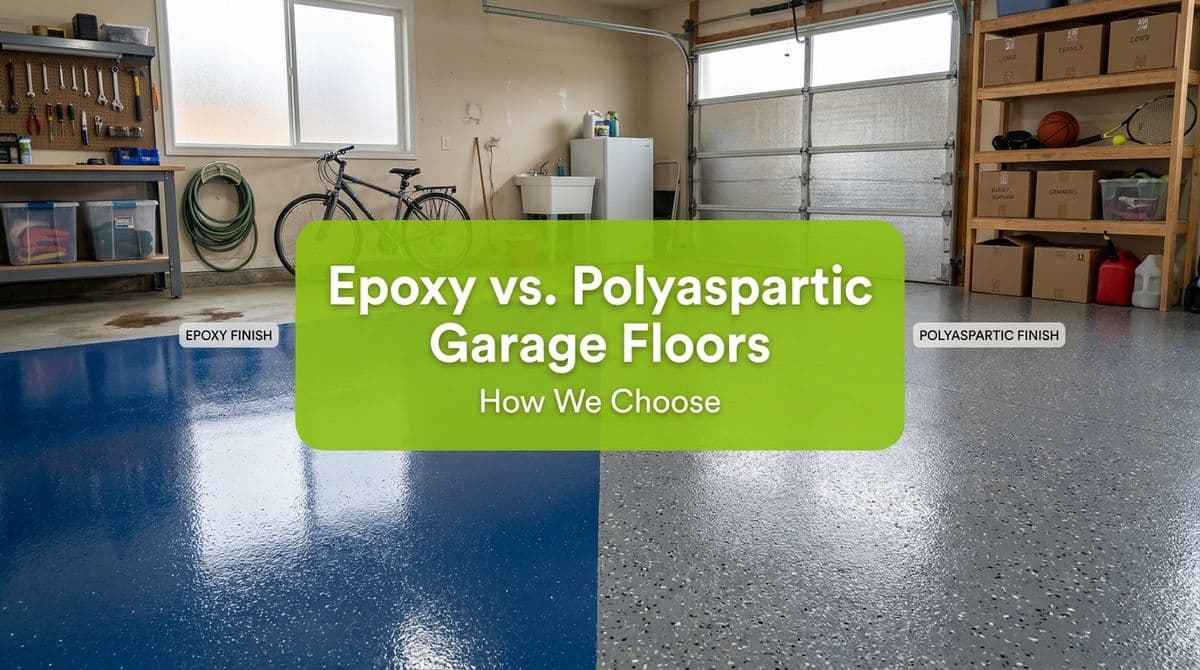
A homeowner’s question we hear all the time
We recently got a call from a homeowner — let’s call him Jason — who had just bought a townhouse and wanted to get his garage floor coated before moving all his stuff in.
Jason’s garage concrete was in pretty good shape. The home was built around 2010, and he’d been doing his homework. His big question to us was:
“Do you recommend epoxy or that poly… polyurea stuff for my garage?”
We hear this a lot. Both systems are great — but they shine in slightly different situations. On Jason’s call, we walked him through how we decide which system fits which garage, and that’s exactly what we’ll share here.
Epoxy vs. polyurea: what’s the real difference?
When homeowners ask us about “epoxy vs. polyurea,” they’re usually thinking in terms of good vs. better. The truth is, both are professional-grade options when installed correctly. The main differences come down to:
Cure time
Temperature sensitivity
Chemical and UV resistance
How rough or damaged your concrete is
For Jason, the concrete was fairly clean, not heavily cracked, and he was on a tight timeline because his belongings were in storage. That combination nudged us toward one system — but let’s break down both, so you can see how we think through it.
When an epoxy garage floor coating makes sense
Epoxy has been the standard in garage floor coatings for a long time, and there’s a reason for that. It’s tough, attractive, and cost-effective for a lot of typical residential garages.
Benefits of epoxy coatings
Great value – For many homeowners, epoxy delivers a strong, attractive floor at a lower cost than pure polyaspartic systems.
Thicker build – Epoxy can be applied a bit thicker, which helps even out minor imperfections and gives a solid, “substantial” feel underfoot.
Good chemical resistance – It stands up to oil drips, road salt, and common garage chemicals when properly top-coated.
Customizable look – We can add color flakes, metallics, and different textures depending on how you use your garage.
We tend to recommend an epoxy-based system when the garage:
Has moderate wear but no major structural issues
Belongs to a homeowner who wants great performance on a budget
Isn’t under direct, intense sunlight all day (epoxy alone can amber without a UV-stable topcoat)
Things to know about epoxy
The biggest thing homeowners like Jason are surprised by is cure time. A full epoxy system often needs:
About 24 hours before you can walk on it
48–72 hours before you can move light items back in
Up to 5–7 days before we recommend parking vehicles
If you’re already moved in, that’s usually manageable. But when everything you own is sitting in a storage unit, like Jason’s was, those extra days really matter.
Why many homeowners choose polyurea
Polyurea is a newer technology that’s become extremely popular for garage floors, especially when speed and durability are priorities.
Benefits of polyurea coatings
Very fast cure time – In many cases, you can walk on the floor within hours and park vehicles within 24 hours, depending on the system.
Excellent UV resistance – It won’t yellow or fade in sunlight, which is a big advantage if your garage door is often open.
High chemical resistance – It holds up very well to road salt, gasoline, oil, and de-icers.
Cold-weather friendly (with pro installation) – We can install it in a wider range of temperatures than traditional epoxy.
Because Jason was just moving in and wanted “the sooner the better” so he wouldn’t have to move his stuff twice, the fast return-to-service of polyurea was a big advantage.
Things to know about polyurea
Polyurea isn’t automatically “better” for every situation. We always look carefully at the concrete first. In some garages with heavier damage or significant pitting, we may use an epoxy or polyurea base layer for build, then a polyaspartic topcoat for UV and chemical resistance.
That’s why when Jason asked, “Do you guys do epoxy or that poly?” our honest answer was, “We do both, and we choose based on what your floor looks like.”
How we choose the right system for your garage
When we stop out for an estimate, we’re not just measuring square footage. We’re looking at the whole picture so we can match the system to your garage. Here’s what we consider:
Age and condition of the concrete – Newer slabs (like Jason’s 2010 floor) often give us more flexibility. Older, spalled, or heavily cracked slabs may dictate a thicker build system.
How you use the garage – Daily parking, workshop, home gym, storage, or all of the above?
Sun exposure – Garages with doors open a lot benefit from UV-stable topcoats like polyaspartic.
Timeline – Do you need it done fast so you can move in, or do you have more flexibility?
Budget – We’ll be upfront about cost differences so you can decide what makes sense.
For many homeowners, the “sweet spot” is a hybrid system: an epoxy or polyurea base for build and adhesion, topped with a polyaspartic clear coat for UV and chemical resistance. That way you get the best of both worlds.
What to do if you’re planning a move like Jason
If you’re in Jason’s situation — new place, belongings in storage, and you want the floor done before moving in — here are a few tips:
Call early – We often book out a few weeks, especially in peak season, though smaller garages can sometimes be squeezed in sooner.
Mention your timeline upfront – Let us know if you’re trying to avoid moving items twice; that can influence whether we lean toward epoxy, polyaspartic, or a hybrid.
Clear the space completely – The emptier the garage, the smoother and faster the project goes.
When Jason called, his timing worked out so we could stop by quickly, look at the floor, and discuss options in person. From there, it was just a matter of matching the right system to his goals and schedule.
Not sure which coating you need? We’ll take a look.
You don’t need to become a coating expert overnight. If you’re wondering whether epoxy or polyaspartic is right for your garage, our job is to inspect the floor, explain your options in plain language, and recommend what fits your situation.
Whether your garage is brand new or has years of wear, we can put together a system that looks great, holds up to everyday life, and gets you back to using your space as quickly as possible.