Epoxy After Concrete Repair: Timing & Prep for Garage Floors
Wondering when to epoxy-coat your garage floor after concrete repair? Learn how long to wait, how curing and moisture affect adhesion, and how to plan around real life.
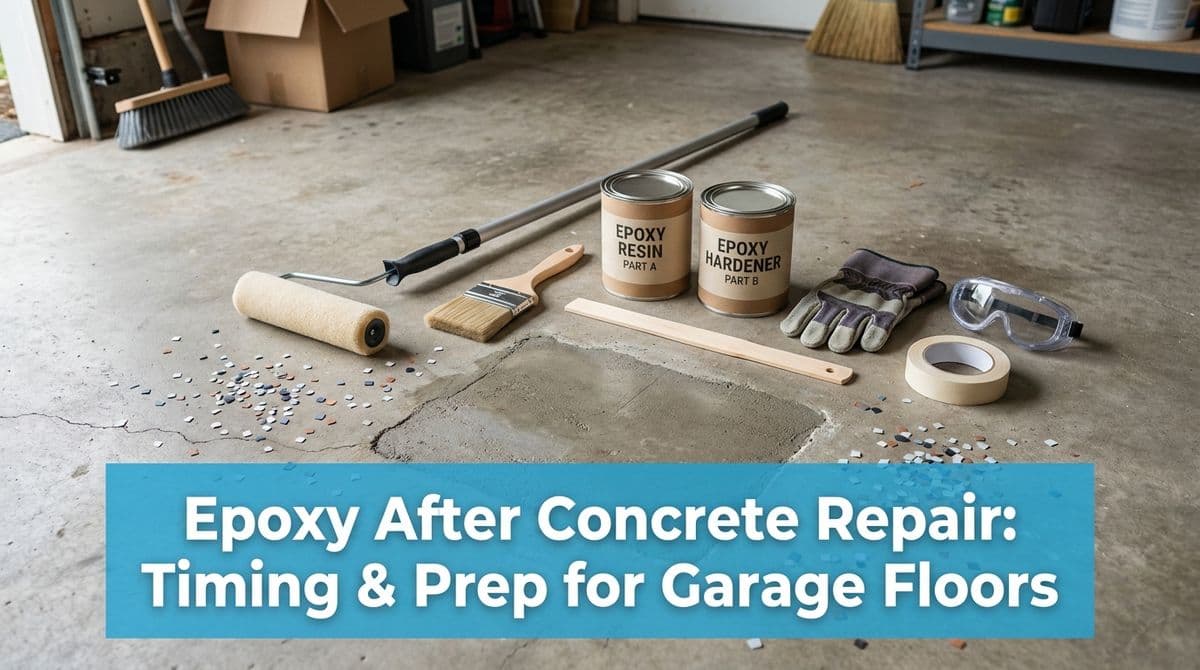
A Garage Packed for a Sale and a Fresh Concrete Repair
We recently got a call from a homeowner — let’s call him Mark — who was in the middle of planning a few big things at once. He was having about three feet of his garage floor concrete replaced, thinking about an epoxy coating, and getting ready for a big neighborhood garage sale.
His main questions were simple but important:
- “How long do I need to wait after the concrete repair before you can epoxy-coat it?”
- “Will the new concrete mess up the look of the coating?”
- “How do we work around the fact that my garage is completely packed right now?”
If you’re wondering when and how to epoxy-coat your garage floor after concrete repair or new concrete, you’re in the same boat as Mark. Let’s walk through what we explained to him, step by step.
Fresh Concrete vs. Old Concrete: Why Timing Matters
When you pour or replace a section of garage concrete, that slab goes through a curing process. Even though it looks “hard” within a day or two, there’s still a lot happening inside that concrete.
Here’s why that matters for epoxy and other coatings:
- Moisture is still leaving the slab. As concrete cures, it releases moisture. If we coat it too soon, that moisture can push up under the coating and cause bubbles, peeling, or cloudy spots.
- Strength is still developing. Concrete continues to gain strength for weeks. A fully cured surface is more stable and better for long-term adhesion.
For a full-depth new slab, most manufacturers recommend waiting about 28 days before applying a coating. For a smaller repair area or partial replacement like Mark’s three-foot section, timing can vary based on the mix and conditions, but we still like to see at least 3–4 weeks, and we may test the moisture before coating.
How We Check If Your Garage Floor Is Ready for Epoxy
Instead of guessing, we rely on a few simple checks to see if your floor is ready:
- Visual inspection: We look for dark, damp spots, efflorescence (white, chalky residue), and cracks or low areas that still need repair.
- Moisture testing: For newer concrete or garages with moisture issues, we can do a basic moisture test to make sure the slab is within acceptable limits for coating.
- Surface hardness: The concrete should resist scratching easily; a soft surface means it’s not fully cured or is too weak for a long-lasting coating.
If anything looks borderline, we’ll recommend waiting a bit longer rather than rushing the job. Coatings fail most often because the slab wasn’t ready, not because the product was bad.
Surface Preparation: The Unseen Work That Makes Coatings Last
Once the concrete is cured, prep is everything. This is where DIY projects often go wrong. Here’s what proper prep usually involves:
- Grinding or profiling the surface: We mechanically grind the concrete to open up the pores and remove weak surface material, old sealers, or contaminants. This gives the epoxy a good “tooth” to grab onto.
- Cleaning and degreasing: Oil and grease spots are common in garages. We use degreasers and thorough rinsing to remove them so they don’t interfere with adhesion.
- Crack and pit repair: We fill cracks, spalls, and pitted areas so the coating has a smooth, even base. On a partial replacement like Mark’s, we pay special attention to the transition between the old and new concrete.
Skipping or rushing these steps can shorten the life of a coating from 10+ years to just a couple. The coating is only as good as the surface it’s bonded to.
Will the New Concrete Section Show Through the Coating?
Another concern Mark had was whether his newly replaced three-foot section would stick out like a sore thumb once everything was coated.
The short answer: with the right system, it shouldn’t.
- Solid-color epoxy or polyaspartic coatings will generally hide color differences between old and new concrete.
- Flake systems (where we broadcast decorative chips into the coating) are even better at disguising patches and repairs, giving a uniform, speckled look.
- We pay close attention to leveling and feathering between the old and new slab so you don’t feel a lip or ridge underfoot.
If your garage has multiple repair areas, we can still create a consistent, professional-looking finish — but that all starts with good prep work.
Planning Around a Packed Garage, Events, and Real Life
Like Mark, many homeowners call us right before something big: a garage sale, moving day, or the start of a new hobby that needs floor space. The timing doesn’t always line up perfectly with concrete curing and coating schedules, so here’s how we usually help people plan it out.
1. Use Your Event First, Then Coat
For Mark, his garage was absolutely packed for a neighborhood sale. In cases like that, we generally suggest:
- Do the event first. Use the garage sale to clear out clutter and decide what’s really staying.
- Schedule a visit after the sale, when we can actually see the floor and measure accurately.
- Plan the coating once the concrete repair is fully cured and the space is mostly cleared.
This way, you don’t have to move everything twice, and we can give you a more accurate plan and price once we see the actual surface.
2. Know How Long You’ll Be Out of the Garage
When we do coat your floor, you’ll need to plan for some downtime:
- Walking: Usually OK after about 24 hours, depending on the system.
- Light items and storage: Often after 24–48 hours.
- Parking vehicles: Typically 48–72 hours after the final coat, depending on temperature and product.
We’ll go over exact timelines before we start so you can plan where your cars and belongings will go for a few days.
Is Epoxy Coating Worth It After a Repair?
If you’ve already invested in concrete repair or replacement, a coating can be a great way to protect that investment and make your garage look finished:
- It helps resist road salt, oil, and chemicals.
- It makes the surface easier to clean.
- It can blend old and new concrete into a single, uniform surface.
The key is getting the timing, prep, and planning right. Wait for the concrete to cure, prep it properly, and schedule the work around your real life instead of fighting against it.
If you’re in a situation like Mark — fresh concrete repair, a packed garage, and questions about when to coat — we’re happy to come out, look at your floor, and help you map out a realistic timeline that works for your home and your schedule.